After climbing out of the Ngorongoro Crater, we began to make our way to the Serengeti. While we were still down in the crater, we asked our driver, Mbaga, how many miles it was to the Serengeti. He told us it was about 75 kilometers (46 miles). Well, after driving more than 2 ½ hours, we realized he meant it was 75 kilometers just to get out of the Ngorongoro Crater!
At around noon, Mbaga pulled off the side of the road (I use that term very lightly), and parked under a tree so that we could have lunch. Our resort put together boxed lunches for us to eat while on our safari. We tried not to think about the fact that the lunches had been riding along with us since 6 a.m. in an increasingly warm jeep! As we sat in the jeep opening up our boxes these young boys cautiously approached our vehicle. They didn’t get too close, but their dog did. He came right up to the jeep, looking for food. These boys are Maasai's.

While we ate, the boys talked among themselves. It was difficult to eat in front of them, seeing that they had so little. In fact, as we finished our lunch, they gave us the international signal for hungry (we see it all the time in Accra from the beggars, especially the street children). The Maasai people and their cattle coexist peacefully with the wildlife in the Ngorongoro Crater, but we were instructed by Mbaga not to feed them. When asked why, he said, “If we feed them today, how will they eat tomorrow?” Basically, he’s saying that we should not disturb the way in which they live and survive, and it would ultimately ruin their culture. He also said that if visitors began giving the Maasai their leftovers, the country would be littered with trash and the safety of the tourists would be in jeopardy (people would surround the jeeps as they stopped). It may seem like litter is a small sacrifice, but I live in Ghana; a country littered with trash. The area may have been dry and desolate, but it was clear of trash.
Before we reached the Serengeti, Mbaga told us that for a price of $50 USD, we could stop at a Maasai village where we would be welcomed with a dance, and an opportunity to see how they lived. We decided that it was an opportunity we just couldn’t pass up.
 |
| Our guide was Palo, one of the Chief's many children. |
As we stood outside of the village, the men began dancing. The men wear bright cloaks of red and blue and almost always have a stick in their hand, which is used to guide the cattle.
 |
Melissa and I were presented with necklaces, which we had to unfortunately return before we left. Check out the earrings on the lady! We were then led into their village where Palo took us to his “house.”

 |
| A typical Maasai "home." |
All Maasai villages appear to be arranged in much the same way, other than some being larger or smaller than others. A thick thorny hedge is usually built around the outside to keep out the lions and leopards. Maasai herd the cattle during the day and bring the animals into the center of the villages at night to keep them safe.
Inside this village we were treated with quite a show of the “jumping dance.” This particular dance is done by the men of the village, who leap….and I do mean LEAP….into the air to show their strength and stamina as tribal warriors.
 |
| Benjamin jumping with the Masaii. |
They first invited Benjamin and then Daniel to join them in the dance. I always thought Daniel had some hops, but let me tell you…..he was put to shame by the Maasii! In the meantime, Melissa was doing a smaller jumping dance with the women.
The huts in the village are primitive and are built by women with mud and cow dung and had thatched roofs. There was no electricity or running water to speak of. There were probably 20 or so huts located in a circular fashion. Palo took us inside his hut which was pretty dark and a bit smoky from the fire, which were basically embers. There were two people sleeping in two “rooms,” one of whom was Palo’s sister and who was literally right behind us laying on a bed. Palo was quite eager to answer any of our questions. He was 26 years old, had already killed two lions, his father (the Chief) had numerous wives, and he was planning on going to school in Arusha soon.

After we left the hut, we were taken to the center of the village so we could see their arts and crafts. See them hanging on the sticks?

The Masaii women followed us from one piece to the other, encouraging us to buy anything and everything. We each picked out one item that we wanted to buy and then Palo told us to follow him outside of the center of the village where we would then negotiate the price. Dave was appointed as our chief negotiator. I have a feeling he is MUCH tougher when dealing with mine unions than he was with the Maasai. In fact, he may have even paid MORE than they initially asked for, but he told me later that after seeing how simplistically the people live, he didn’t have a problem with providing them with some financial assistance.
After the negotiations, we were taken to the Kindergarten school, where children ages 3-7 or so are taught (before they go into town for primary school). As you can see, the classroom is very primitive.

The children were all sitting on benches and were quite well behaved. On the other hand, they were very dirty. Many of them looked sick, with snot running down their faces. I mean….look at their feet. They live in the dirt!

They sang their ABC’s for us and we were encouraged to ask questions. Melissa introduced herself and asked some of the children their names and how old there were. The only curricular material in the classroom was a small chalkboard at the front of the room. As we left, the children were working on math problems - 1+1 = 2, 2+2 = 4.
A long time tradition of the Maasai's is to the drink cow’s blood mixed with fresh milk. The drink is said to be rich in nutrients and fills the people for an entire day. It is also essential to their survival, as water is not always available, especially in the dry season. The blood is obtained by nicking the cow’s jugular vein, just enough to get the liquid, but not enough to kill the animal. Fortunately, we didn’t have to watch this demonstration! Nor did we have a taste of the concoction!
After we left the kindergarten classroom, we were taken back to our vehicle where several of the villagers thanked us for visiting. Oh, and they also offered Dave 20 cows for Melissa….and after much consideration, he turned the offer down. What he may not have known then was that the Maasai measure a man’s wealth by the amount of cattle and children he has. Had he sold Melissa, he would have still had Benjamin, Daniel, Christine, Chap, Brody, and the new baby - in other words he still would have been quite wealthy!
The visit to the Maasai village was one of our favorite activities. While we are sure that it’s sort of staged, and is somewhat of a tourist trap, we still believe that it was relatively authentic and represented real Maasai life.
After MANY hours on the road, we finally came to the entrance of the Serengeti National Park.
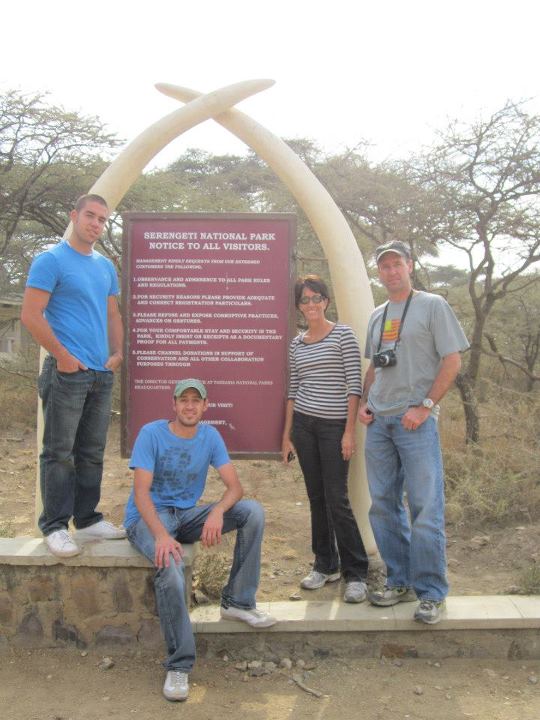
The largest native mammal migration in the world occurs once a year when millions of wildebeests, zebras and gazelles move to areas that provide fresh grazing. Serengeti is a Maasai world meaning “endless plain,” and I can totally see where its name comes from. The Serengeti is massive. The savannah goes on and on and on until it meets the horizon. The Kenyan and Tanzanian governments have identified 80% of the Serengeti as protected areas, and it is obvious. There are very few structures, the countryside is free of litter, and things appear to be in their original state.
You have probably heard the phrase, “The Big Five” game. I had, but just assumed that it referred to the largest animals located in game reserves. In fact, it was actually coined by big game hunters and refer to the five most difficult animals in Africa to hunt on foot. The term was then adopted by safari operators. The five animals include: lion, African elephant, cape buffalo, leopard, and rhinoceros.
We saw all but the rhino….he was elusive. Actually, I guess they are located in the western part of the Serengeti, and we didn’t have time to get over there. Here’s a picture of the leopard.

I found the giraffes to be pretty remarkable. We saw many of them in the Serengeti, including many baby giraffes.

Mbaga was driving very quickly through the Serengeti, and we really didn’t know why. He was really reluctant to stop when we would see an animal, and we finally figured it out at about 6 p.m. when the sun began to set and the world turned into a scary and dark place teeming with wild animals! Prior to sunset, we came upon a family of elephants.

They are just SO magnificent, and I could have watched them for hours. Mbaga, however, was in a hurry and didn’t want to stay long. The queen elephant decided she wasn’t interested in letting us pass, so she stood directly in front of our jeep - she was about 200 yards away. Mbaga would rev the engine to scare her off of the road. The queen wasn’t deterred, and took a step towards us. Mbaga backed up and again revved up the engine. This happened a few times until she decided to let us pass. However, as we drove by her, she turned to us and trumpeted. IT….WAS….SO….COOOOOL!!!
As we got closer to our lodge, we were driving in complete darkness. Keep in mind that there are no lights in the Serengeti, other than those of our headlights and from the stars. Daniel coined the last stretch of our drive as “Gazelle Alley,” as there were tons of them continually darting across the road.
We finally arrived at the Serengeti Soroi Lodge, and once again pulled up after dark so had no idea what our lodge actually looked like. We were graciously greeted by the workers, given something to drink, a towel to help remove some of the dirt on our faces and hands that had accumulated after a day of a dusty drive through the two parks.
We were escorted to our rooms by the locals, and told that we should not leave our cabins without an escort. We would be picked up and taken to the restaurant after we had showered. Benjamin and Daniel were sharing a room. He came over to tell me that there was only one bed in the room, much to he and Daniel’s distress. I explained that first, there was no phone in the room, and second, I wasn’t going to put myself in any immediate danger by walking to the lodge to ask for a change of room. They bucked up and I never heard another word about it until a few days later when I was asking the kids what was the best thing and the worst thing about the trip. Daniel piped up, “The worst thing has been being sick,” (think some of the food didn’t settle too well with him in Zanzibar). Benjamin inquired, “You mean sleeping in the same bed wasn’t worse?” To which Daniel replied, “The honeymoon suite is just barely above the diarrhea.” I got a laugh out of that one!
The rooms at the Soroi Lodge were again pretty basic, but mostly comfortable. We all had mosquito nets over our bed, and everything around us was SO quiet and DARK. Even the lights barely cast a shadow. Our shower was located outside on the deck.
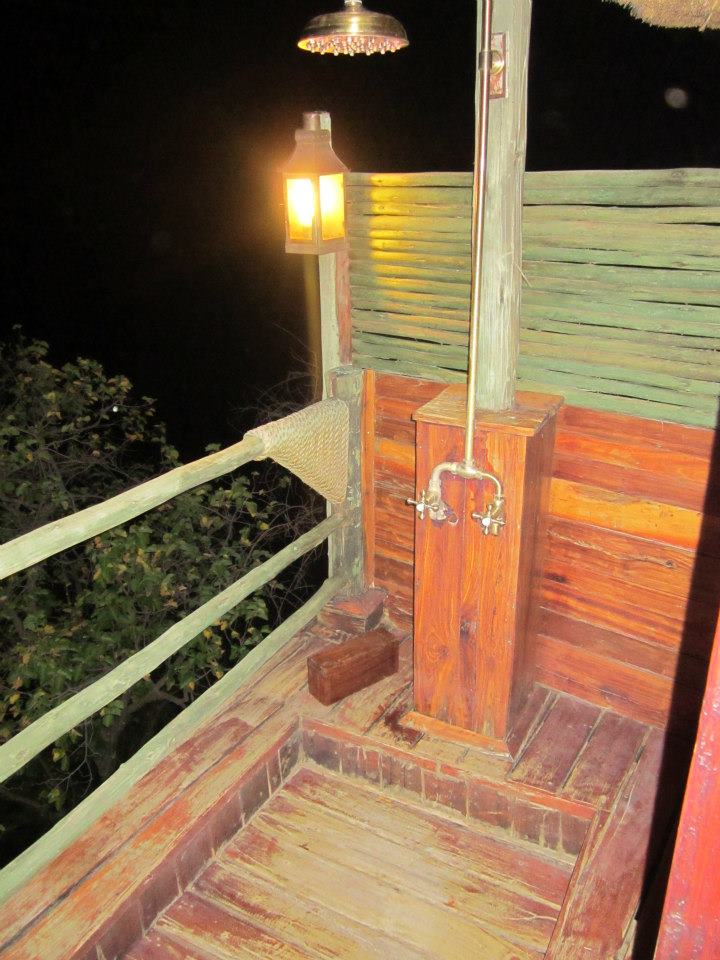
While I think most of my group was a bit daunted by showering outdoors for all to see (it was EXTREMELY private in terms of other cabins being able to see), I felt totally liberated. There was just something about being out in the nature in the buff that sort of appealed to me.
After another interesting dinner (menu items many times alluded us - didn’t really know what we were going to get), we returned to our room where we all went to sleep. We had to be up at 4 a.m. the next day as we were going on a balloon safari first thing!
After a 4 a.m. wakeup call….well, let me explain, as it was an unusual wakeup call. There were no phones in the rooms, and so at 4 a.m., a guy came down the wooden path leading to our room and yelled, “Wake up!” Anyway, we hopped into the jeep to begin our day in the Serengeti, beginning with a Balloon Safari. After about an hour and half ride in the dark, we arrived at a clearing where a balloon and accompanying basket were laying on their side.

There were workers sort of scurrying around and we watched as they tried to start the big red fan. The fan was needed to fill the balloon up with air, so it was pretty important. Unfortunately, the guy was having problems getting it started. It was a machine typical to a lawnmower where you pull the cord to start the engine…except the engine wouldn’t start. Eventually, they determined that the fan was out of gas. In typical Ghanaian fashion (yes, I KNOW we were in Tanzania, but this was exactly what I would expect in Ghana), they hadn’t thought to bring extra gasoline. So, the little guy jumps in the jeep and hauls down the road on a mission to find some gasoline.
About 20 minutes later, and after a short safety brief, he returned. The fan was filled up with gasoline, and quickly started. The balloon had four little areas in which people would be standing. Our pilot was in the middle, in order to easily access all of the controls. The rest of the compartments held four people. While Melissa shared hers with others, Benjamin, Daniel, Dave, and I were in the same compartment. The basket was sitting on its side, and we were each instructed to slide in and lay on our back, after connecting the harness. As the balloon filled up with air, the balloon slowly started to go upright. Once it was completely upright, we were basically sitting on a little shelf, at which point the pilot told us we could stand up.
And there it was….my first hot air balloon ride. We rose into the air quicker than I expected. Because of the gasoline misfortune, we didn’t actually get to see the sun come up over the horizon, but nonetheless, it was a spectacular view of the horizon.

The ride was much, much louder than I expected, as every 30-40 seconds he had to fill the balloon (or the more technical word, envelope) with hot air. It was also quite warm in the basket; much warmer than I expected.

The ride was smooth and when the burners weren’t on, it was very peaceful. It wasn’t scary at all. When the burners weren’t on, it was very similar to the experience I had parasailing in Key West - calm, quiet, serene. The pilot took us along a river, where many animals could be found. We saw these enormous crocodiles quickly slither into the river as we passed over, scared by the burners.

We also witnessed a family of elephants who were quite bewildered by the sound as well. They seemed to be running into each other, into trees; anything to get away from the noise.

We flew over a lone elephant, and were told by the pilot that he was injured. He said the elephant had a swollen limb and that he would likely die soon.

Our flight was about an hour long, and I can’t believe how quickly the time went. Before we knew it we were getting ready for our landing. It was just a bit bumpy, but overall, pretty uneventful. After we disembarked, we all gathered into a circle where the pilot told us the story of the very first balloon flight, which culminated in the drinking of champagne - both in the story and in our morning.

After toasting our adventure, we climbed into the jeeps and were driven to an area by which we were treated to a delicious breakfast on the plains of the Serengeti.

There were baboons hanging around the area, but the workers kept them at bay. At one point, I just had to visit the “loo with a view.” There is no door on the other side. It’s wide open, and as I was doing what I needed to do, a baboon walked by. So…..strange!

After breakfast, we headed off for another day of safari with Mbaga. We arrived at this area where there were no other vehicles, but there were a ton of lions. They were just lazing around and didn’t even really seem bothered by us. We counted 11 total, and it was amazing how close we were able to get to them. One of the female lions had an infected eye…..if only the vet in our family was with us!
Our next stop brought us to this spot where we witnessed a Wild Kingdom moment! At first, all I could see were the vultures, but then it became clear….they were going at a dead cape buffalo.

Mbaga told us that the buffalo likely died of a disease or an injury, because he appeared to be mostly intact. If he would have been hunted by lions, the vultures would only be eating the small scraps the lions had left on the bones. We watched in fascination as the vultures tore through the thick hide of the buffalo and pretty much pulled out the guts. One vulture pecked out his eye, while another one pecked at his nose. It was sort of gross, while captivating, all at the same time. It was interesting to watch the vultures as they tried to earn their rightful place in the pecking order.
While stopped at this location, a random hippo ran by. Literally….he was running, and he actually moved quicker than I thought he would considering his size.

Next, Mbaga went off the beaten path as he could see a big group of vultures flying overhead, meaning there was something below that was catching their attention. We ended up coming up on this watering hole.
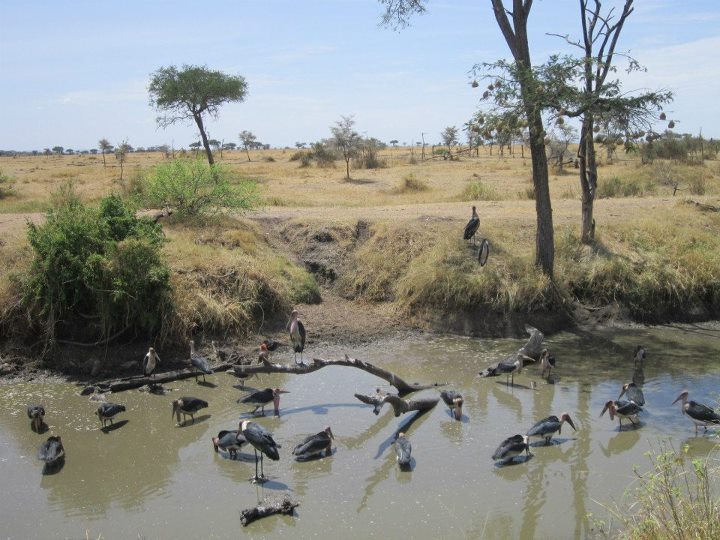
Talk about another Wild Kingdom moment. I think we all agreed that what we watched unfold was one of the most fascinating hour of our entire trip.
While we ate our lunch, we watched the many Marabou storks catch fish.

The watering hole only appeared to be 8-10 inches deep, but there were actually some pretty large fish in the water. When a stork would catch a fish, he would gulp it right down….or, if another stork tried to fight him for it, he would fly off with it, hoping to get it down before it was stolen. Other fish were so large that the storks could not find a way to swallow it whole and ended up releasing it back to the water.
Eventually, a family of baboons came to the water. They looked to be getting a drink, but two of them got into a “fight.” Have you ever heard a baboon scream? It’s scary! They chased each other around before finally settling down.
The entire time we were parked at the watering hole, there was this single lizard swimming around. Sometimes the storks would peck at him, but he would quickly get away. We saw some smaller rhesus type monkeys up on the hill on the other side of the watering hole. We saw more vultures and a really interesting eagle. I wish I could remember the name of the eagle as he had a really interesting type of “laugh.”
So, now that our tummy’s were full, we were ready to move on. But wait! What was that coming up to the watering hole? Two enormous hippos! We moved closer to them as one of the gingerly walked into the water. As I’ve mentioned before, the Serengeti is SO quiet. As we sat there watching, we could literally hear him (or her) drinking from the watering hole.

Suddenly, we watched as the lizard began to approach the hippo. They sort of had a stare off. It was so funny - this huge hippo staring at this relatively diminutive lizard. Eventually, the lizard swam off to the side and climbed out of the water. Lo and behold….the lizard was missing much of his tail. Guess those storks had actually gotten a piece of him!
 |
| Lizard vs Hippo! |
Remember that lone elephant we saw while in our hot air balloon? Well, we saw him a bit closer up while on the ground. His right leg was quite swollen. He seemed very confused and was sort of rocking back and forth. I felt SO sorry for him, and wished there was something I could do. Mbaga told us that maybe the park rangers would get him some help, but I’m not so sure. I think it’s just part of the circle of life and that at some point he would become so weak that he would then become food for some other species.
After a really incredible day out on the Serengeti, we returned to our lodge for dinner and a well- deserved night of rest!
Next stop….Zanzibar!


